Louis Leblois
An Officer and a SpyLouis Leblois is Georges Picquart’s friend and attorney, and one of the few people in Picquart’s circle who questions the case against Alfred Dreyfus. His importance lies not in a dramatic courtroom speech but in the work of reading, advising, and choosing where evidence should go. As the Dreyfus affair moves from military secrecy toward public dispute, Leblois helps Picquart recognize the weakness of the secret dossier and devise a route for bringing his information before a respected political figure.
Identity and Background
Leblois is a lawyer and Picquart’s old friend. They met as students at a lycée in Strasbourg, where each had lost a parent at the age of eleven: Picquart his father and Leblois his mother. Picquart remembers this shared bereavement as an unspoken bond between them, a private connection that persisted into their adult friendship. Leblois is described as Picquart’s age, neatly dressed, with a carefully trimmed beard and quick, precise hands. The narration presents these details as signs of a methodical character: when he reads, he orders his thoughts on the page with the same neatness as his appearance.
The book identifies Leblois among the lawyers involved in the affair, alongside Fernand Labori, attorney to Émile Zola, Picquart, and Alfred Dreyfus, and Edgar Demange, attorney to Dreyfus. Leblois’s position is distinctive in the evidence shown: he is Picquart’s friend as well as his legal adviser, and his work repeatedly takes place outside a formal courtroom, through private consultation and decisions about how information can be used.
Doubts About the Dreyfus Trial
At a dinner among Alsatians, Leblois is the one person at the table who voices even a small reservation about the case. While others repeat generalizations about Jews and loyalty, he objects in principle to secret trials. He also wonders whether a Christian officer would have been denied the ordinary judicial process and points to a newspaper account suggesting that the evidence against Dreyfus is thin. His intervention is cautious, framed as a lawyer’s concern with procedure rather than a declaration that Dreyfus is innocent.
Picquart answers that national security required a closed proceeding and insists that the evidence was ample. Leblois does not continue the argument; he adjusts his napkin and allows the conversation to move on. The scene establishes both the limit and the significance of his dissent. He does not yet openly challenge the military account, but he identifies the unequal procedure and evidentiary weakness that Picquart is not prepared to acknowledge. Against the confident prejudices voiced around the table, his legal question keeps the issue of fair process in view.
Leblois also appears at Dreyfus’s court-martial as counsel opposing the request for a private hearing. When the prosecutor argues that the case involves national defence, Leblois immediately rises and insists that Dreyfus has the right to be treated like any other accused person. The objection does not prevent the proceeding from being closed. It nevertheless makes visible the conflict between the defendant’s ordinary rights and the military’s claim that secrecy is necessary.
Legal Work and the Secret Dossier
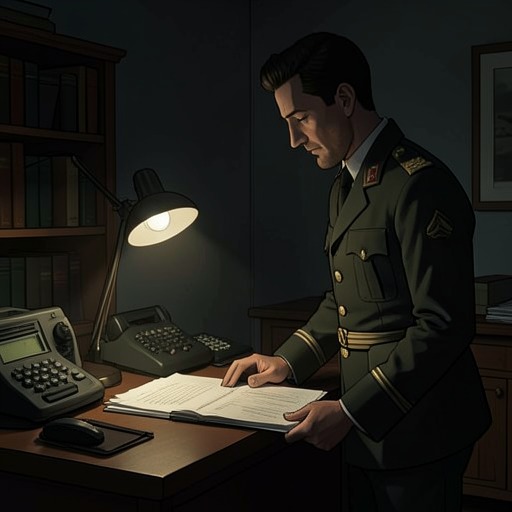
Picquart asks Leblois to examine a file concerning the carrier-pigeon affair, offering to pay him for the work. Leblois accepts, opens his briefcase, and begins reading a sheaf of papers at Picquart’s desk. The two work in companionable silence for an hour, recalling their earlier closeness as classmates. When Hubert-Joseph Henry enters unexpectedly, Picquart introduces Leblois as a friend preparing a legal opinion. The scene shows their friendship operating as practical collaboration: Leblois’s legal skill is enlisted to test military business against professional scrutiny.
The same habit of examination becomes consequential when Picquart opens the envelope containing the secret file. It holds five documents, including Hubert-Joseph Henry’s account of the allegations. On reading the material, Picquart finds circumstance and insinuation rather than a document or witness that directly identifies Dreyfus as a traitor. The closest link is an initial. Leblois is not shown conducting this particular examination, but his earlier role as legal reader gives the broader inquiry a procedural counterweight: the claims must be assessed as documents, not accepted merely because officials present them as secret evidence.
Leblois’s legal perspective also informs Picquart’s understanding of the files as politically dangerous objects. Military officials can restrict who sees them and what can be said about them; a lawyer can examine their contents, identify what they do and do not establish, and consider how a challenge might be made without simply surrendering it to the press. That work does not itself settle the case, but it helps convert private doubt into a question of evidence and procedure.
Advice, Strategy, and Risk
When Picquart turns to Leblois with information that could put them both in danger, their personal closeness is paired with a frank warning about professional and political consequences. Leblois arrives after court; Picquart’s sight of him restores his nerve. Picquart explains that even having the conversation could expose Leblois to professional and political danger, and that there is no promise of where the matter will lead. Leblois listens as Picquart prepares to disclose what he has found.
Leblois responds with strategy rather than a call for immediate publicity. He tells Picquart not to speak to anyone, arguing that doing so would serve their opponents, and proposes to carry the information himself to a public figure of unimpeachable integrity. His choice is Auguste Scheurer-Kestner, Vice President of the Senate. The plan is an attempt to outflank the military authorities: not to publish the material at once, and not to hand it to the Dreyfus camp, but to place it before a figure whose standing might compel serious attention. Leblois thus takes on the task of moving knowledge from a restricted personal circle into a political channel while trying to control how that transition occurs.
Public Exposure and Professional Silence
Later, a newspaper account describes a midnight visit to Leblois’s home after Ferdinand Walsin Esterhazy has formally accused him of giving Scheurer-Kestner a dossier based on documents supplied by Picquart. According to the report, the visitor cannot get Leblois to open the door. A voice from inside says that he is bound by professional silence, denies having anything to say, and warns the visitors not to name Picquart. The episode reaches the reader as a published report, not as an independently established account of everything that happened at the door. Its significance is nevertheless clear: Leblois’s legal duty of confidentiality has become both a shield and a conspicuous part of the public dispute.
Picquart reads the passage aloud in a clubroom; by the time he finishes, the room is empty. The silence around Leblois’s reported silence links private loyalty to public suspicion. He had agreed to carry Picquart’s information toward Scheurer-Kestner, but when challenged by the press he does not publicly explain the chain of evidence. In the material shown, that restraint leaves his role exposed to accusation while preserving the confidence on which his legal work depends. Leblois’s contribution is therefore defined by a persistent tension: he helps make scrutiny possible, yet his profession requires him to withhold the very explanation that might make his actions plain.